What to expect and lookout for when buying a RV Camper – a Hard Hitting, DIRECT analysis…
RV Predators Part 2 – Welcome Back! Didn’t read part 1? Its right HERE. Part 1 introduced you to John (here’s his video.) John is clearly a victim of the RV industry. His problems while most directly attributable to “his” dealer, extend to the manufacturers of the (junk) campers he purchased.
In part 1, I also gave you some background info about me. We then discussed corporatism in the RV industry and how it impacts you and I. The article closed with a brief narrative warning about private label rv campers. One example of these “to be avoided at all costs campers” is the Heartland Mallard. It is sold by Camping World. As you shop for campers, know that Mallard is NOT the only private label brand out there!
In this post, we’re going to talk about several areas and terms often encountered when purchasing an RV camper. Misconceptions with these terms and products are widespread. We will discuss: 4 season campers; “extended warranties”; new vs. used campers; and what to be aware of if you’re considering trading in a camper. In my final post in this series (an upcoming Part 3), we’re going to talk about how to reduce your expenses as an RV traveler.
So, with all that said, lets get to it “RV Predators Part 2″…
My camper has a sticker that says “4 Season Package” – Is it REALLY a 4 season camper?
Let’s talk about produce in a grocery store. When produce is labeled “organic”, the term carries REAL meaning. By law organic produce is grown under different conditions than non-organic produce. In the RV world, the “four season camper” claim/label carries absolutely NO meaning or requirements! In other words, there’s no government “4 season camper” certification.
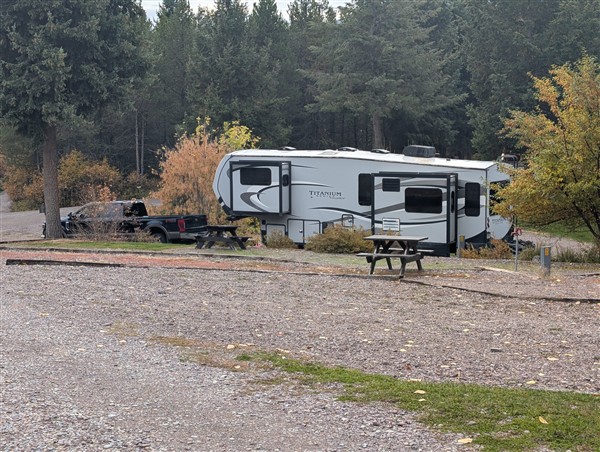
This is why when John asked the salesman at Camping World about a “4 season sticker” not being present on the camper they were showing him, they were absolutely LYING when they told him “we haven’t had a chance to affix it yet, but this IS a 4 season camper.” Yep, believe that and I have a bridge in Brooklyn to sell ya!
First, other than their dealership name, dealers generally do NOT affix any stickers on campers. AND… even if a “4 season” or “all season” sticker IS present, it means absolutely NOTHING! In other words, there is NO Federal or State authority or agency that “certifies” RV Campers as “4 season” or “all season.” In sales, its known as “puffing.”
As a result MOST “four season camper” claims are 100% worthless. When I wrote my “true 4 season” camper post, I was SERIOUS that my camper (a fifth wheel) was one of the FEW that truly IS a 4 season camper*. I only made that claim after extensive research through which I developed an understanding of what the manufacturer did to support their claim. I have since put my camper to the test by camping in -40F conditions!
Key Attributes needed to call a camper “4 Season” or “All Season”
Incidentally, and briefly, each of the following should be present to stay in a camper during extreme cold:
- Dual pane or thermal windows
- 2″ thick high density insulation board in the walls
- heated underbelly with 3 layers of insulation (generally r-foil and fiberglass layers), same in the roof
- 12 volt heat pads on at least the fresh water tank
- minimal to NO exposed plumbing outside of the heated underbelly
Even then, when I’m in the mountains in the winter, I apply a skirt to the camper and often rent a 120 gallon propane tank to ensure I keep the underbelly heated (this is where the plumbing and tanks are.) Further, I install a small heater in the rear compartment of my gas absorption fridge to keep the ammonia mixture from freezing up.
With these “extra precautions”, I can run my camper in the middle of January as if it were July. Having stayed in numerous RV parks for over 10 winters now, I can attest that without a well built and fully prepared RV, you WILL run into trouble. And… trouble often equals expensive repairs!
Next topic… Extended Warranties
As an RV Traveler, I chose a Medicare plan that would enable me to obtain medical care wherever I go…
When I turned 65 a couple of years ago, I did extensive research on Medicare, medicare advantage and medicare supplement plans. Learned the difference, and made a very important decision. As a traveler, I knew it held great consequences. Here’s my journey and a report on the choices I made. Choices YOU may wish to consider as well, visit… “Medicare for RV Travelers”
Extended Warranties – More Appropriately called Extended Service Contracts
To call these agreements “extended warranties”, I believe is misleading. To most people, a “warranty” on a vehicle is “bumper to bumper” (or in the case of a towable, a bumper to hitch) protection. It is associated with what you get with new vehicles and new RV’s. In the case of an RV, the manufacturer’s warranty is generally a ONE year agreement. Most manufacturers breathe a sigh of relief when YOUR warranty runs out. Some manufacturers even “specialize” in running out the clock so YOU are on the hook for THEIR shoddy construction!
As a result, I prefer the proper name for these agreements – an Extended Service Contract. It’s usually a 12 page or so agreement that virtually no one reads. The dealer will be happy to charge you thousands of your hard earned dollars for these plans, and they’re laughing all the way to the bank as profits on these contracts when sold by the dealer are often in the HUNDREDS of percent!
You MUST know what an Extended Service Contract DOES and DOES NOT cover
Once you read it, you’ll see why I now recommend people generally “self-insure.” That is, take the money you would have spent on an “ESC” and set it aside. In most cases, lots of this money will remain in your account when the contract (that you did not purchase) expires!

Here’s the skinny on what to know about ESC’s for RV campers:
- ESC’s generally ONLY cover components – these are things that “do work” in your camper. The fridge, furnace, air conditioner, slide motors, etc. They do NOT cover any structural issues, slide issues including misalignment (other than the motor), leaks, etc.
- They do NOT cover costs to diagnose an issue. For example, in my first 5th wheel, when my landing gear failed, I paid the 2.5 hours labor to take it all apart so the tech could assess what was wrong. THEN (and only then) did the ESC company pay the labor and parts to repair it. The $300+ diagnostic fee was on me. AND there’s a $100. deductible (often) on each repair.
- They often have strict rules for how to report an issue or start a claim. AND if you fail to follow those rules, its cause for an immediate denial!
- SOME do have a schedule for what they’ll pay mobile RV techs, but then you have to get the tech to agree to work with the ESC company.
All considered, I’ll self-insure thank you!
Lastly, DO know this (big tip!) – if you have “buyers remorse” after the finance office at a dealer pushes you to get one of these ESC things, you CAN sell the contract back through the issuing dealer for “time unused” less a nominal fee.
New vs. Used
John reported in his video he purchased a Georgetown motorhome (yuch!) with ONLY 4000 miles on it. He was told by Camping World that it had such low mileage on it, it would carry the original manufacturers warranty. Really?!
Hmmm…
Here’s the REALITY. First, there is a VERY definable line between NEW and USED RV’s. A new RV (all of ’em) carries an MSO (Manufacturer’s Statement of Origin). This is held by the dealer until the camper is sold. The MSO is then registered with the state. Once that is done, the camper is then and FOREVER used.
Here’s why NEW vs. USED RV Camper designation matters
MOST RV manufacturers issue a 1 year bumper to hitch warranty on their NEW camper ONLY for the FIRST purchaser. Once its sold, subsequent owners have NO warranty from the RV manufacturer. The ONLY exception to this is on motorhomes where the engine/transmission/chassis are warrantied by a third party such as Ford or Mercedes, Freightliner, or Spartan. In these cases, the chassis is covered by the chassis manufacturer (including engine, transmission, drivetrain) until it expires. In many cases that’s after 3 years or 36,000 miles of travel. The chassis manufacturer doesn’t care if you’re the original owner or not.
Incidentally, when John ran into trouble with his Georgetown, he threatened to complain to CW Corporate. Yeah, like they care!
Ready to trade-in your RV Camper? Whoa there! Not so fast, before you do realize this…
I wrote an extensive analysis on trading a camper in a post HERE. If you want an in-depth treatment of this topic, read that post! For now, allow me to share a few highlights:
Trading in a camper will likely get you thousands (tens of thousands?) less than you’d get if you sold the camper yourself. (Incidentally, my Concierge RV Service also serves RV owners who are looking to sell their camper.)
Big point #1: Dealers want to purchase your camper for as little as possible as they plan to make a profit on it when they sell it. Realize they’re also making a profit on the one you’re trading it for. Incidentally, the “as little as possible price” is known to industry insiders as “actual cash value.” It is NOT a published figure and is BELOW wholesale pricing.
When it comes to tradein’s, dealers know two important facts: They don’t know if there’s anything they’ll have to fix on yours in order to sell it. They also don’t know how long it will take for it to sell. As a result, they build in “padding” in their offer to you for both repair costs and depreciation that will occur before it sells.
Further, they try to hide the actual value they place on your trade by making a seemingly good offer on your trade. How do they do this? Slight of hand! They appear to overpay on the trade, but will not come down as far on the one they’re selling you!
I tried to educate a customer once at the RV store where I worked a decade or so ago. The sales manager offered them a deal that looked like this: Ours (the one we’re selling) would be $60k, theirs was valued at $20k. The difference? 40k – that is how much actually was coming out of their pocket to get the new camper.
When I delivered the offer, the wife had a big scowl on her face. I immediately asked what’s wrong? She didn’t think that $20k was enough for her “golden” trade (aka beat-up, used camper.)
Me being the quintessential New Jersey native wise-ass, I immediately said, ok, we’ll give you $30k for yours, now ours is $70k and the DIFFERENCE is STILL $40k. The wife was confused. The husband understood the meaning behind my “lesson.” You see, many (most) dealers will over-value a trade so as to NOT piss-off the customer! My sales manager actually tried to be honest in the values we offered the customer.
Bottom line when it comes to trading in a camper…
About the only time it makes sense to trade a camper is if you’re living in it and you can pull yours up door to door with the one you’re buying. This will enable you to move your “stuff” directly from one to the other with a minimum of effort. Otherwise, I’d sell it privately. Again, I’m here if you see value in my Concierge Service.
It’s not about what you EARN, it’s about what you KEEP. Let’s talk about PRESERVING WEALTH…
Want to learn more about purchasing Goldbacks? You can visit my preferred vendor HERE. A “1 Goldback” (contains 1/1000th Ounce of Gold) now sells for just over $8. It will float as the spot price of gold floats. Note: Be advised – while Goldbacks provide unprecedented ability to trade for goods and services, they do carry a relatively high premium relative to “spot gold.” This however works BOTH WAYS – ie – you pay a premium (relative to spot price) when purchasing AND get well over spot price if you sell them back to a vendor.
Concluding Thoughts…
In this article, we’ve covered four very important topics that many rv buyers WILL encounter. As more people look to live full-time in their campers, having a true 4 season camper is important. Winters across much of our nation get cold, summers get hot and 4 season campers can resist the extremes keeping the interior more comfortable. In other words, superior insulation helps in the summer as well as in the winter.
Understanding the in’s and out’s of an extended service contract prepares you for the “pitch” that WILL come your way when you buy a camper. Also, understanding the meaning of new and used and understanding manufacturers warranties will help to counter any misinformation delivered by the RV dealership.
New vs. used, “now you know.” And lastly, the merits and pitfalls of trading a camper. To be informed is to be armed with valuable information.
Stay tuned for my next post… Saving money as you travel in your RV (coming soon)
Need “tried and true” RV Accessories? My personal recommendations…
Like my content? As always, I’d love to hear from you. Please leave a comment below and sign up for my free newsletter to be notified of upcoming posts.












Thanks for bringing up these really important red flags about RV sales tactics — it’s easy for people to get swept up in the excitement and miss the details. Your advice on insisting on full documentation and getting pre-purchase inspections is spot on. I also think newer owners could benefit from having a trusted mechanic or RV-savvy friend walk through things with them.
Steve,
Wise points and thanks for kicking-in on these issues.
Al
Great article Alan! I’m looking forward to next article “saving money.” I’ll be moving into my Northwood Arctic Fox full time in December.
Thank you sir! Good luck on moving in full time. I will have the next post up in a day or two (hopefully.) Where are you at where you’re going to start full timing? What is your first planned destination? Al
I’m staying here in the East for 2026 summer in Michigan. Fall in Vermont. And I’ll be out West in 2027 and plan on wintering in McCall, Idaho.
Nice, the RV Resort in McCall is really nice if that’s where you are planning to stay, however there’s a FAR more affordable rv park in Donnelly about 10 miles South of McCall (easy drive) Al
You are a rock star. I continue to watch and learn from each post.
Thanks Larry, you’re a scholar and a gentleman! Al
Another good explanation and description of the industry’s misleading and often outright fraudulent practices. It’s almost like if the dealer/salesman’s lips are moving he/she is lying. In extreme cold, do electric/propane refrigerators operate better in electric mode or propane? And, I had never thought of a small heater for the back of the refrigerator-you have a recommendation?-And if electric, how do you get power to it? Keep up the good work-thanks for the information.
2 way fridges run more efficiently on propane (good question!)
i position the heater where it can’t melt any wiring!! and run a power cord out thru the slats in the cover to the power pedastle