
ALSO… RV Buying Tips: What to look for in an RV Camper so you have the BEST chance of surviving and thriving during crazy winter (and summer) weather
I’ve gotta share… THIS POST was INSPIRED by the recent winter storm that impacted much of the nation and especially the deep south… allow me to share what I observed –
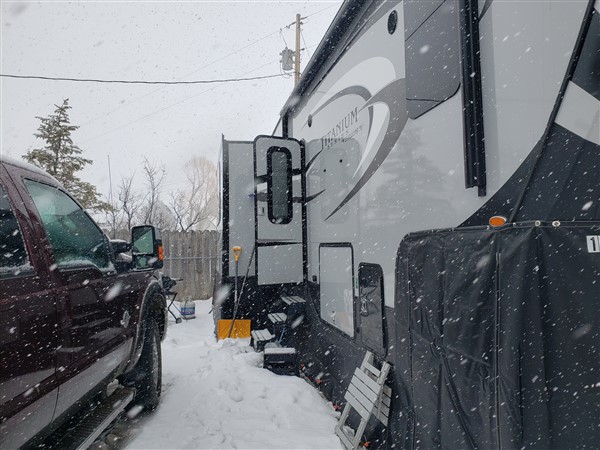
I’m writing this post in late January 2026. As I watched the recent winter storm develop and travel across much of our nation, bringing ice, snow and COLD air, I was absolutely AMAZED at the LACK of understanding and preparation exhibited by MANY RV’ers who were posting in various Facebook groups. Some literally HOURS before the storms arrival.
Most of their problems were caused by cold weather, and not necessarily the ice and snow (though some had some interesting issues they were trying to tackle.)
Here are a few REALITIES regarding RV Camping and RV Life…
- KNOW what you’re getting into. Understand the machine, how it works and how to care for it.
- KNOW the difference between a WELL and POORLY constructed camper.
- KNOW where and how you’re going to use it and what CHALLENGES you’re LIKELY to encounter!
RV’ers NOT prepared for cold weather
Here’s a BASIC fact: EVEN in North and Central Florida (and CERTAINLY farther north), temperatures drop below freezing in the winter, sometimes WELL below freezing. And on occasion, it lasts for a few days!
Yes, I know this recent storm was one of the more extreme events, but I personally experienced nearly a WEEK of subfreezing weather near Austin Texas in the winter of 2020 – 2021, where temperatures (literally) plummeted to 0F one morning.
While this was unusually cold for a long period, temperatures down to 15F DO occur at least once in every three winters in South-Central Texas. Do you need to be prepared if you’re in an RV? YES! Do you need to do everything I do in my 5th wheel where I stay in the Northern Rockies ALL WINTER? NO!
The reality is that severe winter cold DOES occur across much of our nation and with more RV’ers living FULL TIME in their campers… it pays to BE PREPARED for the inevitable.
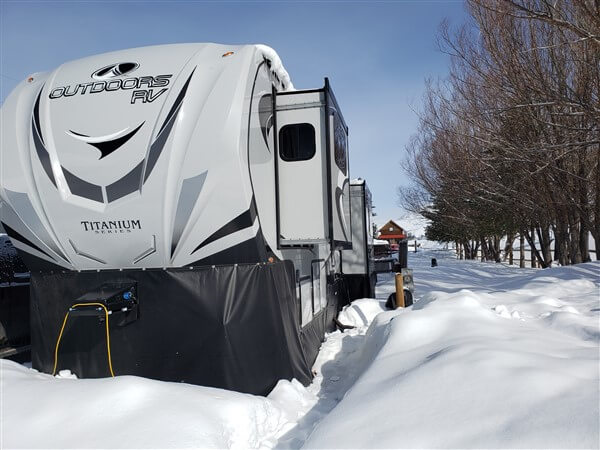
Let’s start here – 4 Season RV’s DO exist BUT they’re NOT common
About 10 years ago (before my days as an Independent RV Consultant), I worked summers for an RV dealer in Casper, Wyoming. Among the wealth of things I learned, I understood that some campers were WELL insulated and others had virtually NONE.
Insulation matters. In both warm and cold climates. As with any RV dealer, our campers sat out on a paved lot all day and Casper in July can (often) approach 100F! When I had the inevitable shopper show up at 2pm in the middle of July, I KNEW our campers would be HOT – like sauna hot!
This was the case with our Forest River Cherokee’s, Arctic Wolves* (NOT Arctic FOX*!!!) and Jayco Jay Flights. It was NOT the case with our Outdoor RV’s. The Outdoors RV is a well insulated, TRUE 4 season RV camper (trailer.) There was typically a 20F difference in the interior temperature of an Outdoor RV trailer when compared to the others as the insulation “resisted” the summer sun.
*Arctic Fox is a Northwood camper – superior is almost every respect; Arctic Wolf is a Forest River product and is substandard in almost every respect!
For me, this translates into LOWER summer cooling AND low winter heating costs. In fact, in the winter, I don’t need to run my furnace (which heats the underbelly including the plumbing and tanks) until overnight temperatures drop below 20F.
What I’m describing here is a “signal” of a true 4 season camper. Honestly, I can name on ONE HAND the number of trailer (towable) manufacturers who make RV campers like this. HOWEVER, there’s NO shortage of the number of manufacturers who CLAIM “true 4 season” about their camper. AND… of course, RV salesmen are only too happy to repeat this claim to naive and unsuspecting victims… errr… RV buyers.
The same can be said about motorhome manufacturers. A few are well engineered, MOST are not.
An important side-note…Removing ice and snow from your campers roof and slides
I’m often asked HOW and WHEN ice and snow should be removed. First, snow on the roof and slides (within reason) is a GOOD thing. It provides additional insulation! But, too much is a problem.
How much is too much? Well, as you may know, snow comes in different “flavors” – wet snow and dry snow. When I wintered in Steamboat Colorado and the snow was “dry.” I allowed up to 18″ to accumulate on my roof and 8″ on the slides before feeling the need to remove it. When I was in McCall Idaho, the snow was quite wet. I would not even allow half that to accumulate as the water content made the snow much heavier.
As to snow removal from the roof of an RV… climbing on the roof is NOT optimal. IF the snow was dry, I am a bit more willing to do so. BUT, this device enabled me to do much of the job from ground level – far safer! I like this particular roof rake as its blade is adjustable – great for slides that are more narrow. My roof rake is more like this one with a 23″ blade, this can be an issue with more narrow slideouts.

When considering COLD weather RV camping and purchasing an RV camper, key questions to get answers to include:
- How thick are the walls and what is inside them?
- I want to hear at least 2 inches and high density insulation board (like blue board) – NOT fiberglass!
- Tell me about the windows… are they dual pane or thermopane or the equivalent?
- Is the underbelly HEATED and INSULATED. If so, how?
- I want to hear insulated with at least 2 layers of fiberglass (pink panther) and a layer of R-foil
- I expect to hear its heated by a furnace port dedicated to the underbelly
- In the case of a motorhome, I want an insulated and heated water bay
- Is the ceiling insulated at least as well as the underbelly?
- Fun Fact: I enjoy seeing my camper to be the LAST to have snow melt off the roof – a sure sign of a well insulated camper
- Is the fresh water tank in a protected, heated area?
- This is OFTEN a problem with Class C campers and sometimes with other campers
A final and IMPORTANT point on 4 season camper claims…
When we go to the grocery, produce labeled “organic” is supposed to have been grown and treated in a specific manner, right? So, the term ORGANIC has a specific and legal meaning.
The term “4 Season Camper” does NOT carry the same weight! In other words, the RV industry has ensured there are minimal (if ANY) regulations on RV’s and RV claims. This means any manufacturer can make almost any claim about any camper and get away with it! Bottom line: The claim “4 season camper” means virtually nothing unless you KNOW how it was constructed.
THIS is in part why I exist as an RV Consultant! I KNOW who the good manufacturers are and who builds JUNK. I also have my clients “back” and work to get them the RIGHT camper at the BEST POSSIBLE price.
Key Tips for Cold Weather Preparation in your RV Camper
As I pointed out earlier, even the deep south can get quite cold from time to time. And it only takes a matter of hours before you’re in REAL trouble if you’re NOT prepared! So, here are some tips…
- Keep your propane topped up – especially if a storm (in any season) is approaching where the power may go out (and NEVER buy an “all electric” camper!!)
- Tip: IF you have 2 tanks, have only 1 open, when it funs out, open the 2nd tank
- IF you have a gas absorption fridge (propane/electric) – switch it to PROPANE when the temperature falls below freezing. This will lessen the risk of the fridge failing.
- Have BACKUP sources of energy! Here is a recent post on RV Camping without shore power on the cheap.
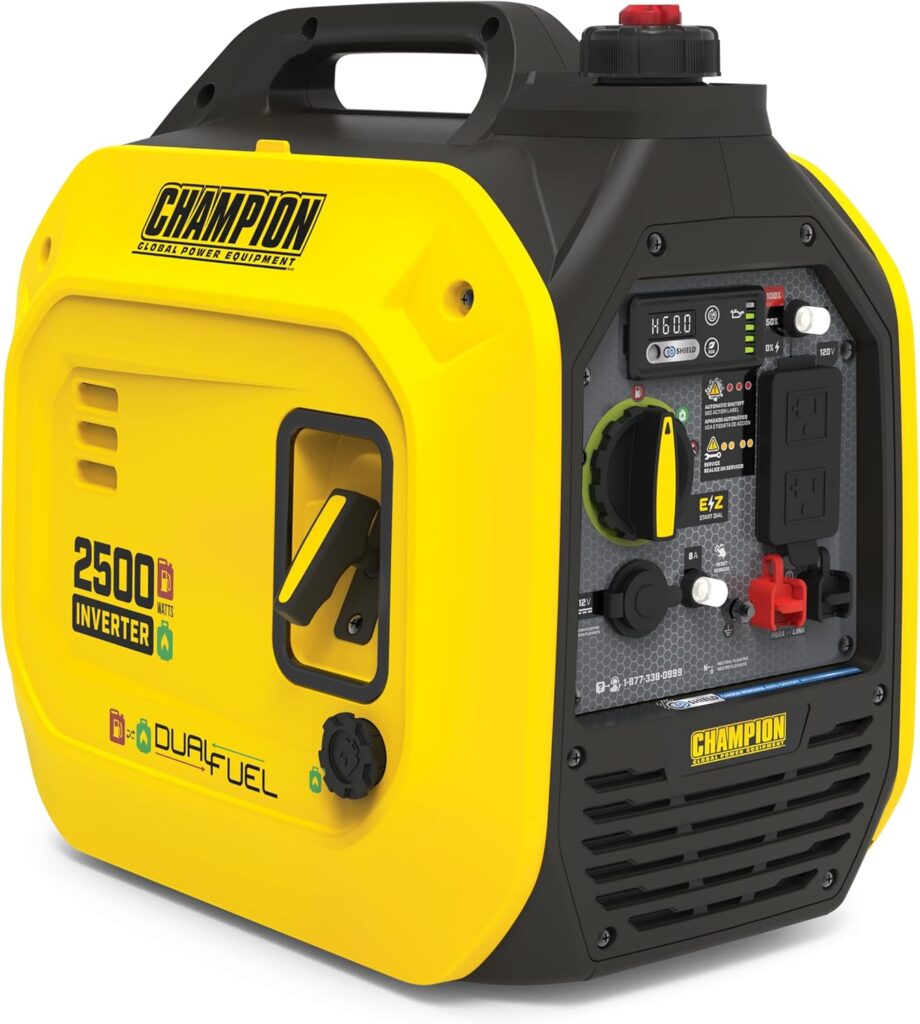
- Have a GENERATOR – here’s an INEXPENSIVE, LIGHTWEIGHT and DUAL FUEL generator that I use.
- Get 3M Indoor Window Insulation – it DOES make a difference! And it does NOT block the outside views. (This is an inexpensive and effective tool for insulating window areas.) I prefer it to R-foil on windows!
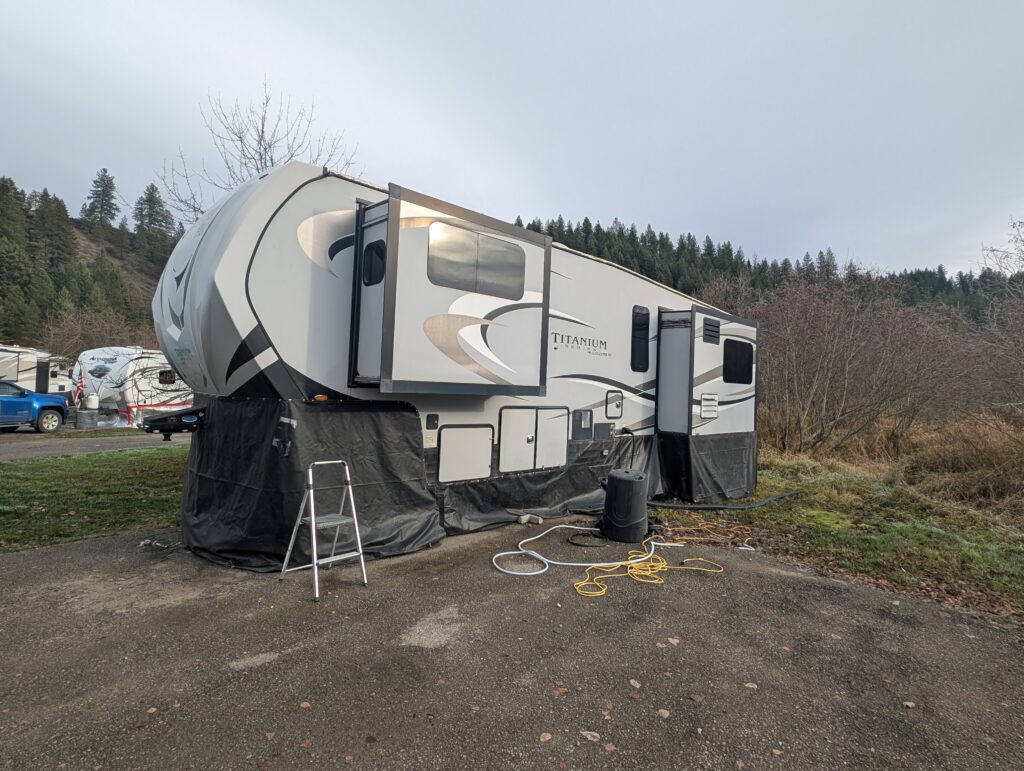
- SKIRT your camper – best planned in advance – here is a “poor man’s approach“**
- Tip: Skirting your camper will REDUCE your heating costs and lower the risk of freeze ups
- I have an entire section of my website dedicated to Winter RV Camping – if you’re in an area that regularly gets well below freezing, you may find LOTS of good tips (and advisories) there
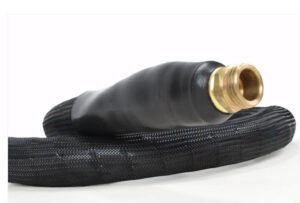
There ARE less expensive heated water hoses, however you’re trading reliability for cost. If you live in a region where let’s say more than 25% of your nights are below freezing, a heated water hose is a really good idea. You CAN create your own – but this heated hose is a FAR more elegant solution!
**I have a good friend in Boise who does a great job with custom RV skirting AND now makes an RV skirting kit that he can ship. Contact me to get a quote.
What SHOULD you know to make the process of purchasing and owning an RV Camper smoother?
In addition to the “4 season” discussion held above, and as I inferred earlier, quality of CONSTRUCTION matters. No, they’re NOT “all crap” as some “experts” say. Some RV’s ARE built better. than others. Years ago, when I bought my STILL current 5th wheel, I wrote two posts that address its construction and why I selected this camper. Much of what Outdoors RV did (then and now)j is what I consider to be a goal for ALL RV manufacturers. For proof in the pudding, here is my camper after 8 years of full time living – including winters where temperatures (LITERALLY) have fallen to -40F!
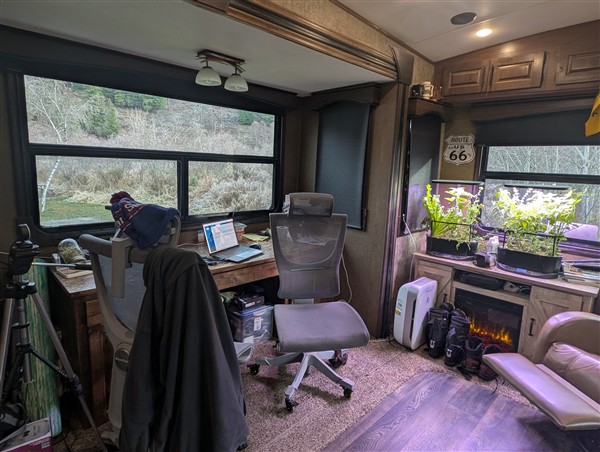
Key Construction Tips for RV’s:
- Know who makes the frame/chassis and their reputation
- Learn how the cabinets are affixed to the walls – it’s the difference between years of trouble free living vs. having the cabinets break off the wall and land on the floor after a bumpy ride
- Know how the drawers are constructed – and of what material. Are they able to handle a heavy load?
- Is particle board with toxic formaldehyde employed in the camper or did they use marine grade plywood?
- Does the manufacturer have a reputation for building a superior product? (Beyond what the salesman says!)
- IF its a 5th wheel, is it “half-ton capable”? IF so, I’d avoid it – they cut corners to cut weight!! (Plus a 5th wheel should almost NEVER be towed with a 1/2 ton truck!
- Do YOU understand the difference between a travel trailer and a 5th wheel? And the benefits/drawbacks of each?
- Is the fresh water tank of sufficient size?
- Are the “tank pulls” electronic or manual? (Manual is more reliable)
Certain manufacturers are KNOWN for making the cheapest thing they can – others are not.
How will YOUR camper look after 8 years of full time living?
Bottom line: Do your research! Get an independent RV consultant to work as your “guide by your side.” Remember, ALL salesmen will find something on their sales lot to be the PERFECT camper for you – regardless of whether it is or it is NOT!
AND by ALL MEANS, get with experienced RV’ers to find out what they WISH they had when the power went out (see my article linked above) and the temperature fell well below freezing.
In closing, I hope I’ve given you some good thoughts to act upon and build from. Please let me know in the space below (comments section) if that is the case. Feel free to Contact Me if you wish to consider my Concierge RV Buying Service.
I also have suggestions for RV Accessories below that can enhance your RV Life and RV travel experience. The links are affiliate links. They cost you nothing more and the income goes to offset my website costs. And… THANKS!
Need “tried and true” RV Accessories? My personal recommendations…
Want to be notified of future posts as they arrive? Sign up for my free newsletter to be notified of upcoming posts.












Thanks for all the tips. I was always told to keep both propane tanks open so you don’t have to get up in the middle of the night when the first one runs out.
I think a good point to remember when winter RV camping is not only a heated hose but recognizing your sewer line can freeze as well. Mine did. The No Freeze people sell a sewer line version but this may be too expensive for most. In the future I plan to use a small ceramic heater behind my skirting. That should do the trick
Nailed it. I am 470 days to retirement and going mobile. You will be my first call.