Lessons Learned – Truly Understanding your campers 12 Volt System and how to troubleshoot problems
As with every RV issue I’ve encountered over the past 15 years of full time travel, when it happens, I try to learn more about the component or system that failed and then share with you how to prevent or address the issue.
This event turned out to be a 12 volt DC system failure. What “symptoms” did my camper experience that brought the issue to my attention? AND… how was the ultimate fix identified?
Let’s start here…
I awoke one morning in early August and was greeted by a low voltage warning on the front control panel of my campers fridge.
Here’s what I already knew about my fridge:
- It is a gas absorption fridge – it can run on propane OR 120 volt AC current
- I was connected to “shore power” (120 volt AC) and had been for weeks (at that time)
- The Control Panel on the front of fridge is powered by the campers 12 volt DC system
So, the warning message was indicating the control panel was not being “fed” enough DC voltage. I checked my batteries and found 11.3 volts. This is NOT a healthy voltage to see on your batteries and an indication the batteries had been significantly discharged.
As my batteries were over 3 years old and had served (well) during cold winters, I realized the solution might simply be to replace the batteries. I knew however that my batteries may not be the only issue and it was time to contact a local mobile RV tech, Steve of Snake River RV & Hitch in Idaho Falls for assistance. Before I get too much deeper in my issue, let’s take a look at what exactly is in your campers 12 volt system…
Note: It is important to know a little about your appliances – if for no other reason than to provide important information to the RV tech you contact. For example:
- Know your appliances make and model number
- For a fridge, know the type of fridge it is – these days there are 3 main types of fridges:
- Gas Absorption (runs on propane and electric)
- 12 volt compressor (runs only on the 12 volt DC system)
- 120 volt AC “residential” compressor – the same as what you buy for your kitchen at home
Ok, back to your campers 12 volt system:
Your campers 12 volt system is vital for an enjoyable and successful camping experience
Many RV owners are often surprised to learn just how much is running off your RV’s “house” batteries. It is NOT true that when you’re connected to “shore power” (120 volt AC current), the batteries are rendered as useless.
I often hear from novice RV’ers the question “When connected to shore power, do I need to keep my batteries connected?” The CLEAR answer is YES and DO NOT disconnect the batteries via the battery disconnect switch!
Which components/appliances in YOUR RV Camper run on 12 Volt DC?
Most RV’ers know that their LED lights run off the 12 volt system. Your furnace, water heater, and refrigerator likely require it as well. The latest refrigerators in fact are being designed as 12 volt compressor units. Older fridges, including mine are gas absorption units. As I noted earlier, the control board on these refrigerators relies upon 12 volt power.
Your slide motors and landing gear (stabilizer) motors are yet two additional components that many don’t think about that run on 12 volt power. Your slide motor must be functional in order to extract or retract your campers slides. And your landing gear motors need good battery power to raise or lower your camper.
With all this equipment relying upon the 12 volt DC power system, you can see its important to keep it healthy!
Medicare for RV Travelers – An approach that works…
As a traveler, especially one who has had some heart issues and occasional skin cancer, I need access to the doctors of MY choice. I’ve found a program that is NOT medicare “advantage” that I personally use and HIGHLY recommend. I wrote an article recently that discusses Medicare and a Medigap Plan that IS affordable and works for RV Travelers.
What exactly IS your campers 12 volt DC “system”?
Within your camper, the main components of your 12 volt system include
- the house battery(s) – in the case of a motorhome, I’m not referring to the vehicle batteries
- the power converter and distribution center
- and a series of 12 volt circuit breakers
- the battery cutoff switch
Let’s spend some time getting to know your 12 volt DC system better…
Your Power Converter is a VITAL part of your 12 volt DC system
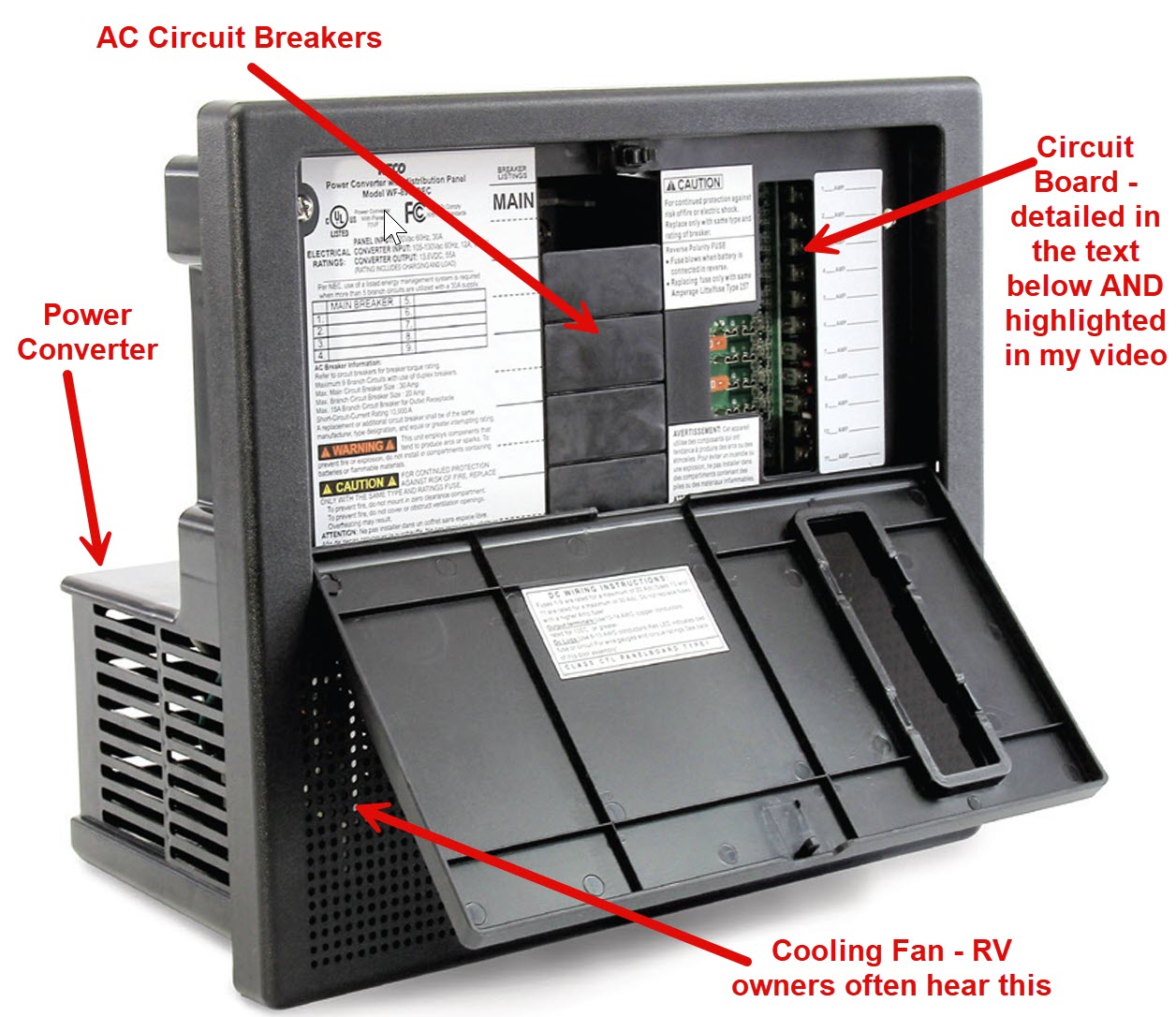
The power converter is a part of the distribution center. WFCO is a common supplier of this equipment. The distribution center also contains a circuit board, fuses, and AC (alternating current) circuit breakers. Let’s dig into this…
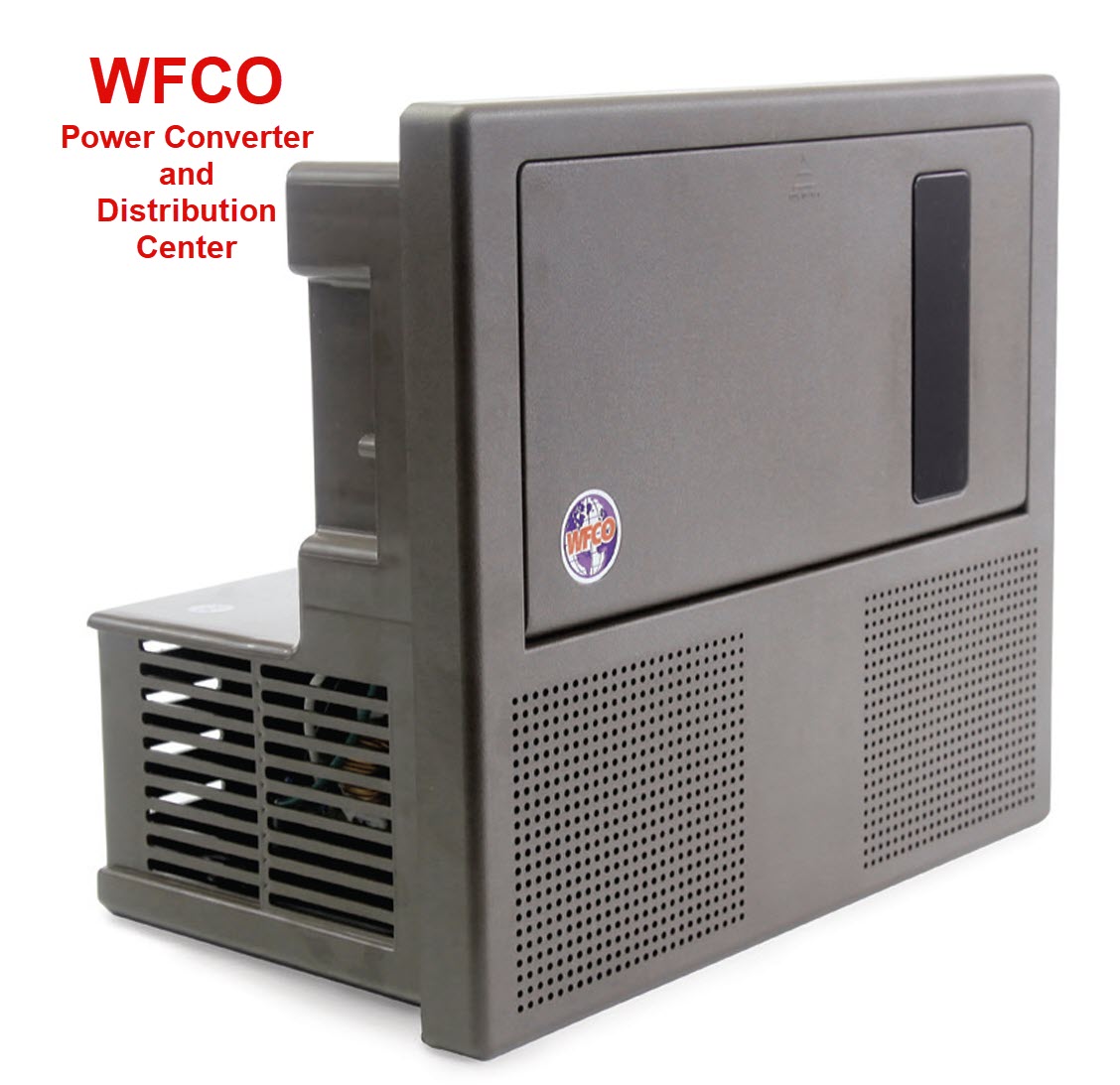
Your power converter has a simple but vital job. It receives 120 volt AC (alternating) current and converts it (hence the name) to 12 volts DC (direct current.) It is the reason your campers “house” batteries recharge and stay charged when connected to shore power or any AC power source powering your camper such as a generator.
If your camper is not connected to an AC power source, your converter will not operate and the batteries need to be recharged by some other means, such as by solar panels or an alternator.
The power converter and batteries have a “2 way” relationship. Yes, DC current flows from the power converter to your batteries, but your batteries also “communicate” with the power converter to let it know what level of charging is required.
Most converters have three stages of powering for the batteries. The voltages supplied by the converter range from 13.2 (trickle charge) to 14.4 (fast charge.) 13.6 volts DC is the “normal” charge level produced by the power converter. The stage the converter “chooses” is based upon the “feedback” it receives from your campers batteries.
I just setup and activated Starlink! (It was EASY)
They have reduced the cost of equipment down to $149. and the 300gb service is $80/month… sounds like a deal to me! Even better – use this LINK and Starlink says you’ll save $100. on your order.
There are additional components between the Power Converter and your batteries – and they DO matter
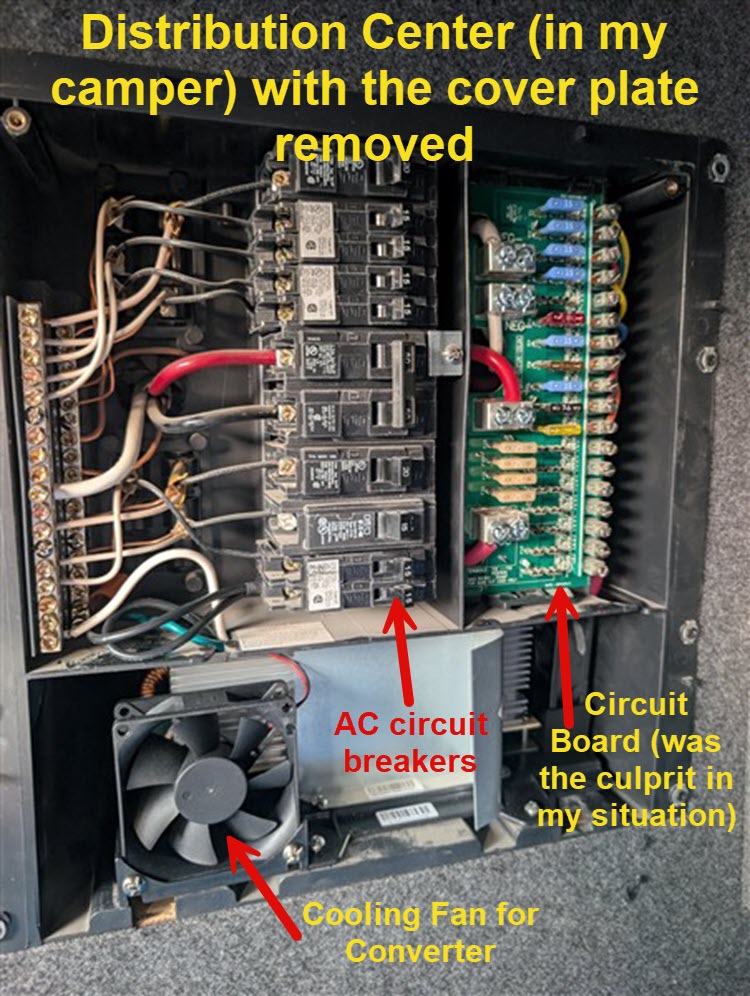
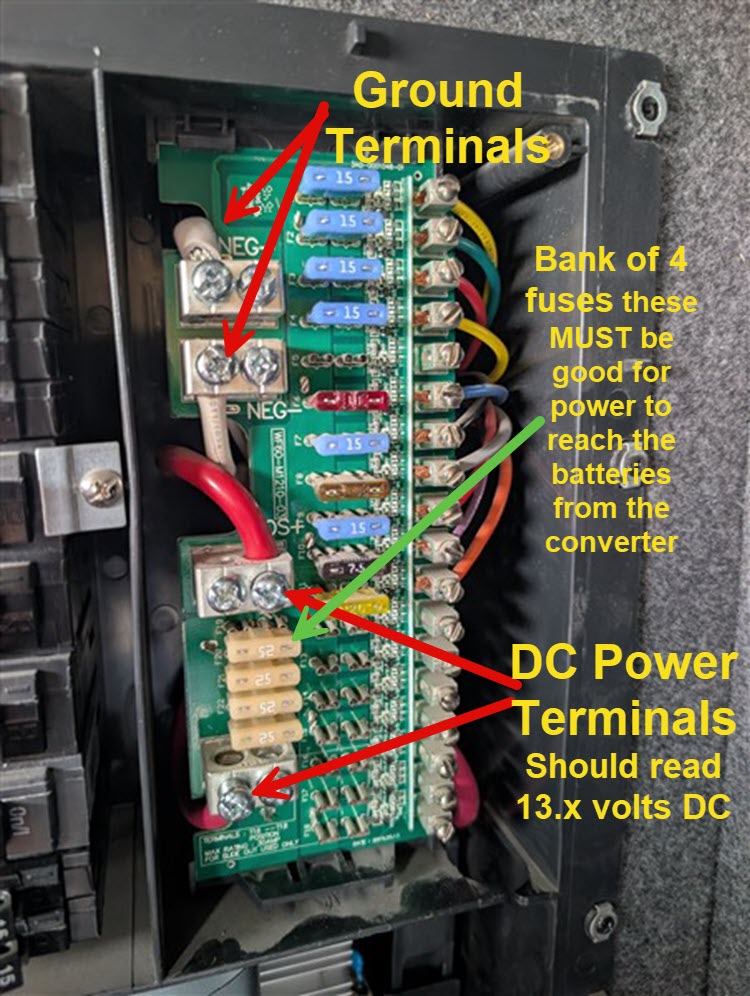
Between the power converter and your campers batteries is a circuit board, 4 fuses, a few 12 volt circuit breakers, the disconnect battery switch, and lots of wiring. The circuit board is part of the distribution center. Let’s take a closer look at the circuit board (and be sure to see my video above where I address the “hidden” issue.
The All Important Circuit Board
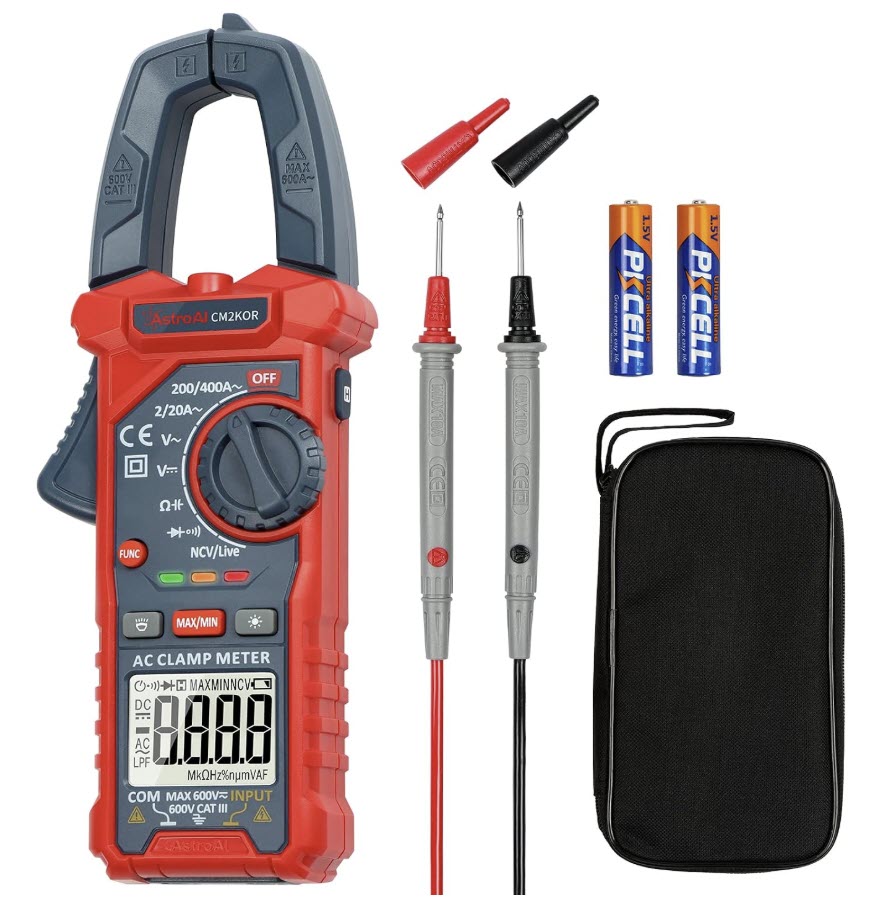
Anytime you’re checking your 12 volt system, you’ll find a multimeter to be your best friend! The model I recommend is the AstroAI. It auto-senses both the voltage range and type of current (DC vs. AC.) It can also detect whether an AC outlet is live.
Your Distribution Center and Converter connect to the batteries
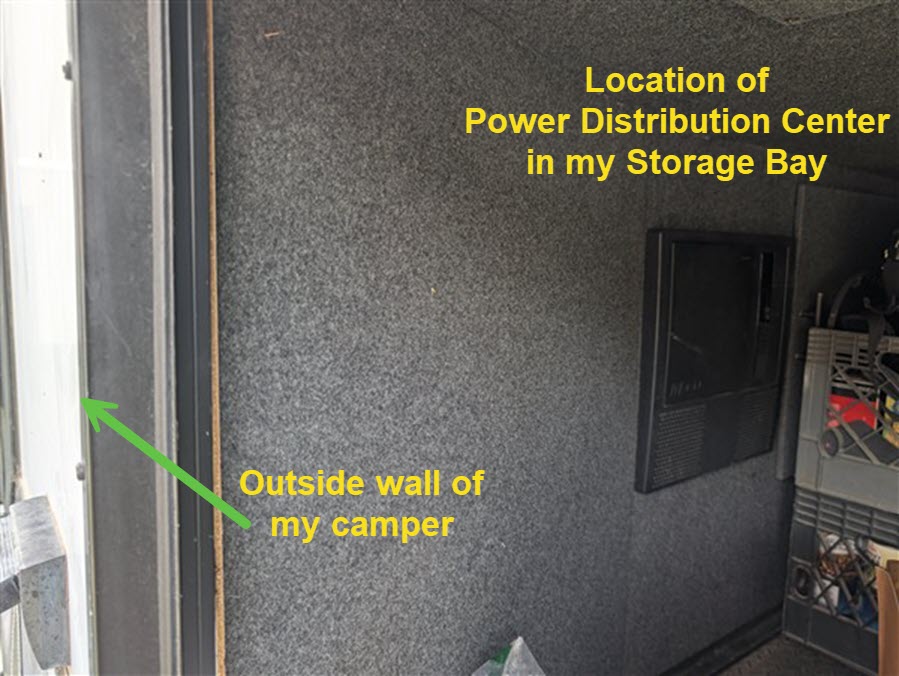
In my campers case, we head across the storage bay to reach the campers batteries. On the surface, the only thing you see before the batteries is the battery disconnect switch.
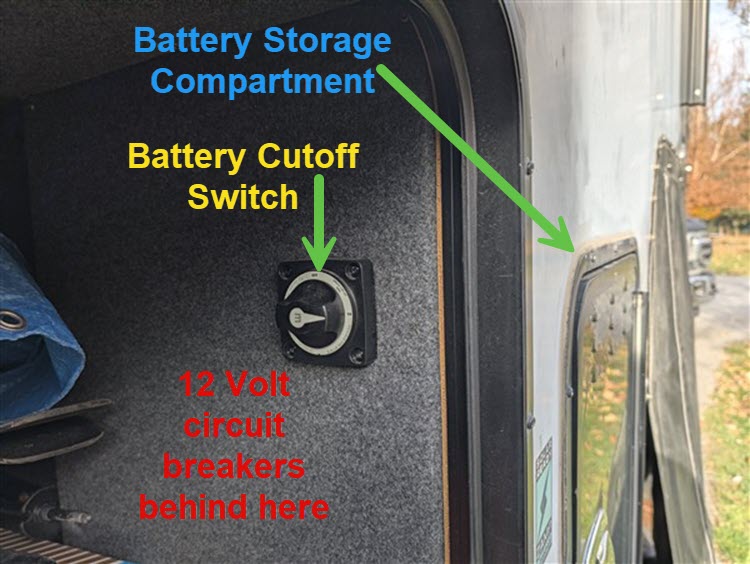
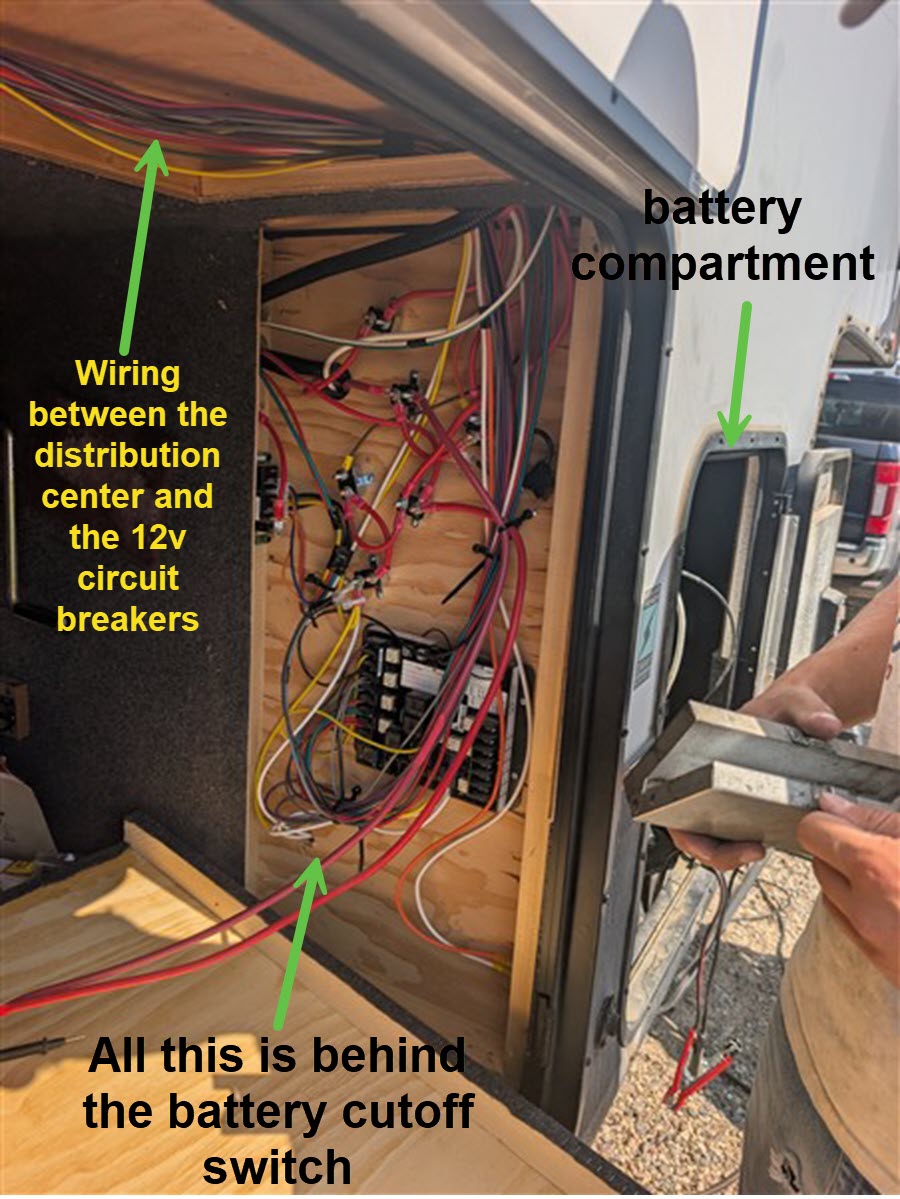
Removing this panel reveals a series of 12 volt circuit breakers – and more wiring! One interesting note: Outdoors RV uses pre-cut wiring and harnesses for stretches like the one across from the distribution center to the battery compartment to ensure the wiring is secure and uniform from camper to camper built on their assembly line. (Just one more reason to appreciate Outdoors RV as a trailer manufacturer! Here’s the story on my own camper.)
A bit more about what happened and how the repair proceeded…
As Steve, my RV Tech in the Idaho Falls, Idaho region guided me through this multi-step repair, he made a house call, first to assess the converter (it had died), then next to replace the converter and install the new batteries (6 volt, deep cycle lead acid Trojans) I had purchased. The pair of batteries was about $330. The converter about $400. The converter that died had provided about 6 years of solid service.
After the converter and batteries were replaced, I continued to monitor voltages – and its a good thing I did! The batteries were once again not being charged by the converter! After further discussion with Steve, he had me remove the distribution center’s cover plate (again) and access the circuit board (please refer to the image above of the circuit board.)
There are terminals where you can assess whether the converter is putting out DC voltage or not. My new converter WAS. However, as you’re seeing there’s quite a bit between the “DC Power Terminals” (labeled 3 images above) and the batteries.
A quick check of the 4 fuses (tan colored – same image) on the circuit board revealed they were fine. The next plan of attack was to expose the wiring behind the battery cutoff switch and check the 12 volt circuit breakers (see detail in image below) to ensure that DC voltage was traveling across those breakers.
Necessary RV Travel Equipment: A 12 volt trickle charger
You should ALWAYS carry a 12 volt DC trickle charger in the event you experience ANY trouble with your campers 12 Volt DC System. A 12 volt trickle charger will keep your batteries charged and save you in the event your converter is unable to deliver DC voltage to your batteries. Victron has a relatively new charger that auto-senses what your deep cycle batteries need (including lithium.) It is the device I recommend. You can learn more about it HERE.
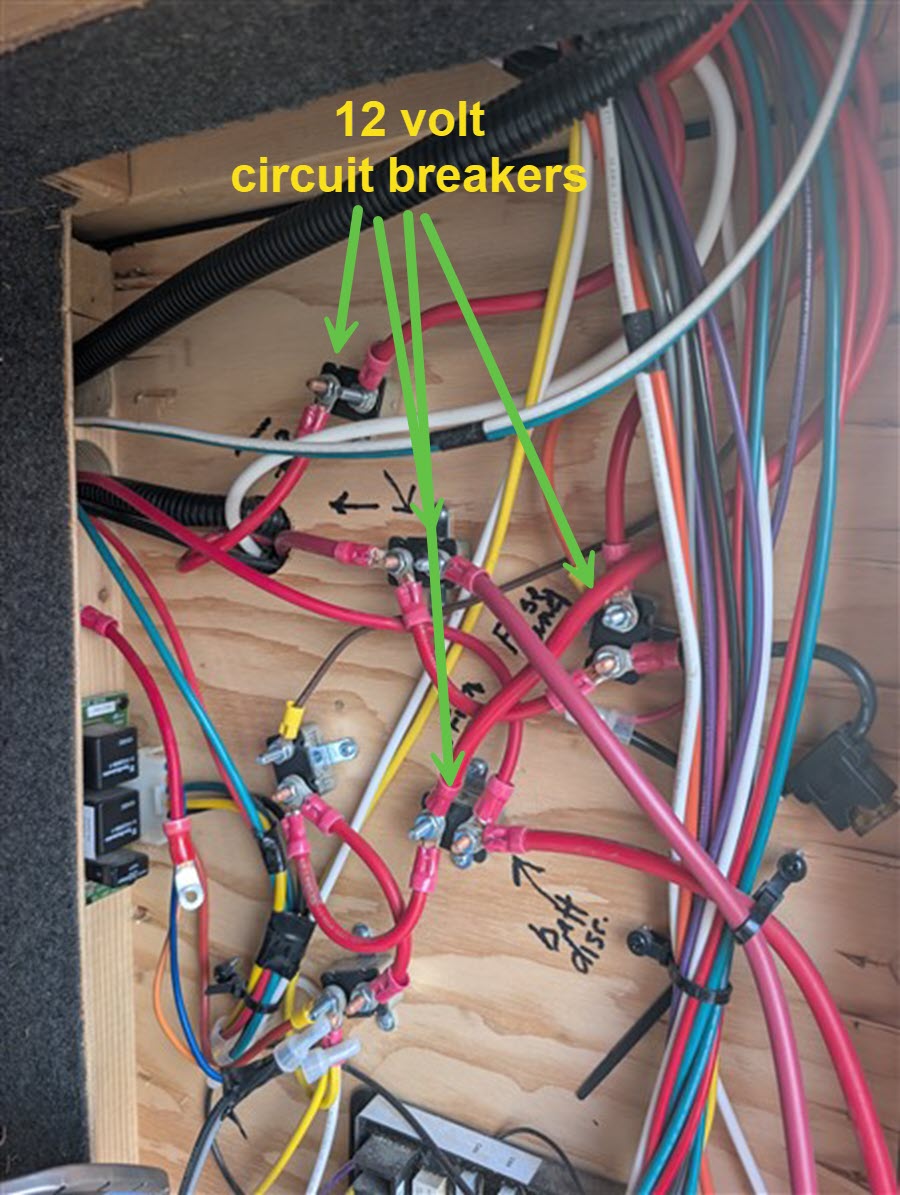
Kudos again to Outdoors RV for clean wiring!
Note: It is important to keep your RV batteries well charged – especially if they are lead-acid or AGM type. Lithium are more forgiving.
Results of Tests and Final Resolution of my 12 volt system issue
After DAYS of testing (remember I had a 12 volt trickle charger serving the batteries and protecting them during this time), we were testing to see if my converter was consistently putting out 13.x volts DC (it was as revealed by testing the circuit board.) Steve also had me test for continuity of voltage across the DC circuit breakers (in the immediate image above), they were.
Since the 4 fuses, converter and DC circuit breakers were all good, the ONLY thing left to suspect was the circuit board. Steve popped it out (it’s a pressure fit in a notch in the distribution center) and saw a soldered spot that may show a failure on the circuit board (see my video and the image below.) He ordered a replacement circuit board, it arrived a few days later and installed it.
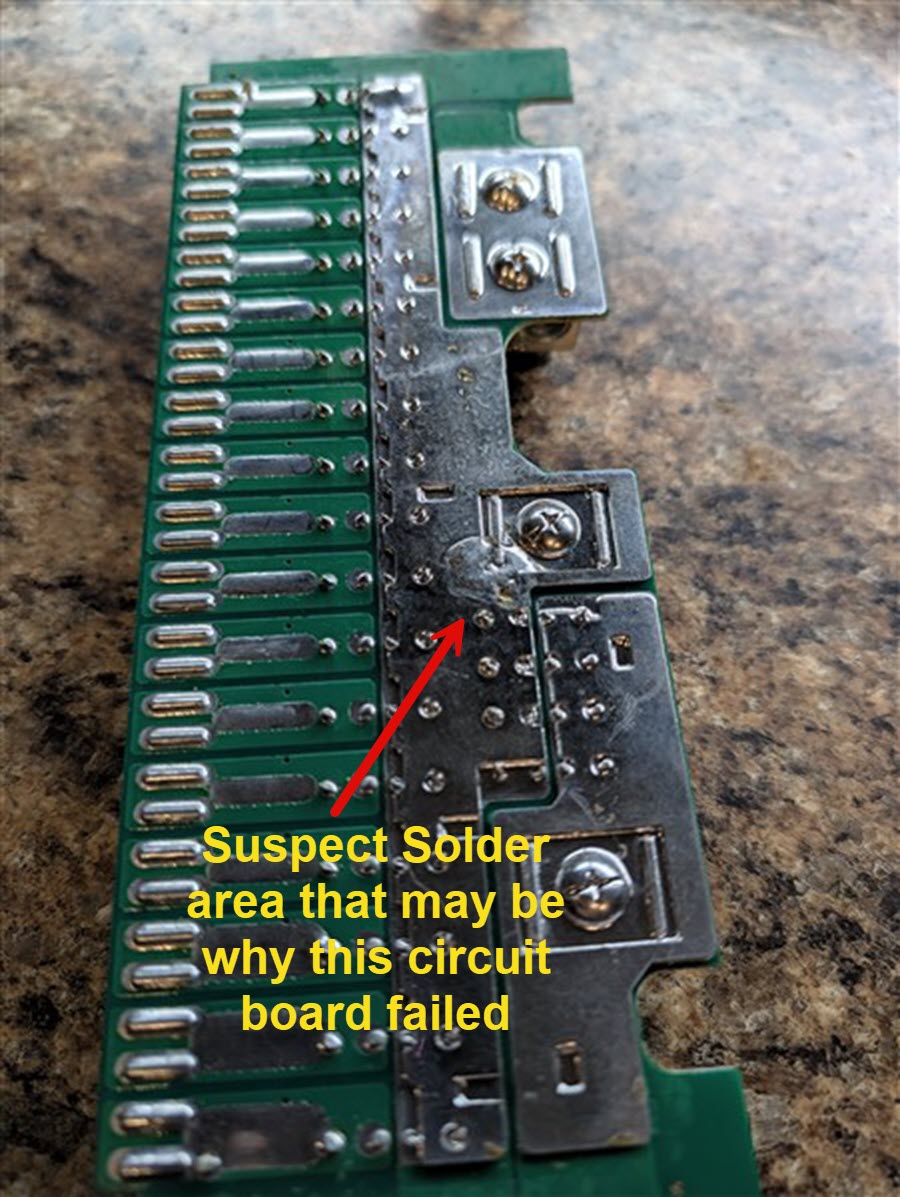
That was about 2 months ago. To date, ALL IS FINE! So, it appears the circuit board was the culprit! It’s impossible to know what failed first. Clearly, my converter had a good run (6 years.) My batteries were over 3 years old, and the circuit board was original to the camper (nearly 9 years old.) So, I can’t fault anything other than the age of the components.
As campers age, yes, you will replace components.
My camper turned 9 years old this month. In the past 12 months, I have replaced the microwave, toilet, and now significant parts of my 12 volt DC system. Soon, I will be replacing a recliner. Of particular importance however, my roof remains solid and the camper is 100% DRY with NO water intrusion.
As recently as last night, it poured (snowed at Lookout Pass!) and I awoke to a warm, dry camper. It’s a nice feeling.
In closing,
I hope this post gives you a greater insight on the intricacies of your campers 12 volt DC system and perhaps how to approach it if you run into trouble. I’m not an electrical engineer and if I have made any mistakes in the above info, please use the space below to advise me of what needs to be amended or just to share your thoughts and insights.
Lastly, please know I’ve now been on the road for 15 years! I have experience in the RV Industry that led me to start my Concierge RV Buying (and Selling) Service. My goal is simple. To help you get the RIGHT camper at the best possible price. I serve you as a consultant, advisor, camper locator, NEGOTIATOR and more to ensure that your purchase goes smoothly and your rights are protected. You can learn more HERE.
Want to be notified of upcoming posts? Please join our free newsletter below. Also – please use the space below to leave a comment or ask a question. I read and respond to all!